11 November 2013

Poppies

Many around the world are enjoying a day off work today.

It's a holiday here and nearly everywhere today.  Armistice Day.  Veteran's Day.  Jour de l'Armistice.  Wapenstilstand Dag.  Waffenstillstand Tag.

On the 11th day of the 11th month at the 11th hour in the year 1918, WWI ended.

In case, like me, you don't know much about it, here's a very, very brief history of how it all happened . . .

World War I began on July 28, 1914, when Austria-Hungary declared war on Serbia. This seemingly small conflict between two countries spread rapidly: soon, Germany, Russia, Great Britain, and France were all drawn into the war, largely because they were involved in treaties that obligated them to defend certain other nations.

The first month of combat consisted of bold attacks and rapid troop movements on both fronts. In the west, Germany attacked first Belgium and then France. In the east, Russia attacked both Germany and Austria-Hungary. In the south, Austria-Hungary attacked Serbia. 

Late in 1914, the Ottoman Empire was brought into the fray as well, after Germany tricked Russia into thinking that Turkey had attacked it. As a result, much of 1915 was dominated by Allied actions against the Ottomans in the Mediterranean. 

The middle part of the war, 1916 and 1917, was dominated by continued trench warfare in both the east and the west. Soldiers fought from dug-in positions, striking at each other with machine guns, heavy artillery, and chemical weapons. Though soldiers died by the millions in brutal conditions, neither side had any substantive success or gained any advantage.

Despite the stalemate on both fronts in Europe, two important developments in the war occurred in 1917. In early April, the United States, angered by attacks upon its ships in the Atlantic, declared war on Germany. Then, in November, the Bolshevik Revolution prompted Russia to pull out of the war.

Although both sides launched renewed offensives in 1918 in an all-or-nothing effort to win the war, both efforts failed.

The war ended in the late fall of 1918, after the member countries of the Central Powers signed armistice agreements one by one. Germany was the last, signing its armistice on November 11, 1918. Germany, under the Treaty of Versailles, was severely punished with hefty economic reparations, territorial losses, and strict limits on its rights to develop militarily.

Many historians, in hindsight, believe that the Allies were excessive in their punishment of Germany and that the harsh Treaty of Versailles actually planted the seeds of World War II, rather than foster peace. The treaty’s declaration that Germany was entirely to blame for the war was a blatant untruth that humiliated the German people. Furthermore, the treaty imposed steep war reparations payments on Germany, meant to force the country to bear the financial burden of the war. Although Germany ended up paying only a small percentage of the reparations it was supposed to make, it was already stretched financially thin by the war, and the additional economic burden caused enormous resentment. Ultimately, extremist groups, such as the Nazi Party, were able to exploit this humiliation and resentment and take political control of the country in the decades following.  Source: SparkNotes
_________________________________________________________________________________

Nearly 10 million soldiers and 9 million civilians lost their lives during this war.

I read recently that about two million visitors are expected to visit the WWI sites throughout Belgium in the next four years in memory of the 100th anniversary of this war.  We have visited a few of them ourselves in the last four years.

And we've seen a lot of poppies since then too.

The poppy became a symbol of remembrance after battles in Flanders when the ground would be disturbed. Flanders is the part of Belgium we live in and today it's the northern half, but Flanders Fields in WWI were mostly in the west on the coast of the North Sea.

Poppies come up anywhere the ground has been disturbed, hence the reason they are associated with traditional battle.  The ones we see today are usually due to construction or farming.


I remember as a kid, people would hand out fake poppies on Veteran's Day.  Of course, I had no idea why and I'll bet a lot of you didn't either.


One important WWI memorial that we had the chance to visit a couple of years ago is the Menin Gate in Ypres, Belgium.  It's a memorial to the missing . . .


all 54,896 of them.

It's called the Menin Gate because it leads to the small town of Menen (Dutch spelling).

Nearly every night since 1928, the Last Post is sounded at the Menin Gate for anyone who wants to listen.


10 November 2013

Save the park


We are lucky enough to have a huge city park nearly in our backyard.  


It's a few blocks from our door and we enjoy it as much as the other residents here.


We've even gotten to take advantage of this nice playground a couple of times :)


Can you believe this was 2 and 1/2 years ago?

So ..... for several months, there has been some controversy over plans to make a new parking garage and a new road through our city park.

The problem seems to be parking - or lack of it.  While the city isn't the ideal location for a hospital . . .


you can see from this aerial view - that's the hospital in the outline and the park to the right of it.

And one of those houses in the bottom left corner is ours!

The proposed parking garage would hold 2000 cars!  That's a lot of traffic going to and from in an already congested area.


Residents' Parking
Save City Park
YES

Symbol for "Parking Garage" + Symbol for "Highway"
NO

Pretty soon after the announcement of the proposed changes to the park, people who live around the park got organized . . . in protest - and these signs began appearing on nearly every house near the park.


These houses face the park so I guess they have more at stake . . . like a really busy road in front of their house? We live right around the corner and we already know what that's like :)

The city administration has taken these protests under advisement.  For the long term residents and for us while we are here, I hope they figure out another way to make it all work.

We'll see.

Red Stadspark.

09 November 2013

Eye of the Beholder

Some time ago I was introduced to this website for an art gallery in Antwerp (Belgium).  I shall name no names to protect the innocent.  The gallery has moved from Antwerp to Brussels, but it still has some pretty interesting/often disturbing works of art on display.

Since finding this gem on the web, I click on their website from time to time to see what's new so I can continue to be amused and astounded at what is considered art.

Now, I know from a reliable source that some and perhaps most of this art sells in the tens of thousands. I kid you not.


B. Wurtz

Untitled, 2001


wood, wire, mesh netting 

109.2 x 50.8 x 25.4 cm

Mesh netting.  In other words, those bags your oranges and onions come in.  And I've been throwing those away for years.  Probably still will.
_________________________________________________________________________________


Christopher Knowles

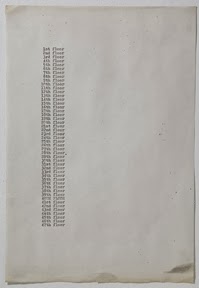
47 Floors CK 1 28, 1975 

typing on paper


Typing on a typewriter on paper.  In case the words are too small, it is a list reading "1st floor, 2nd floor and so on . . . " I have to admit I haven't seen anything like this in . . . well, probably since 1975.  I may have even typed this.  Nostalgia at its finest.
_________________________________________________________________________________


Margaret Salmon

Still from Pyramid, 2013

5-channel video installation

colour and b&w 16mm film on digital, silent

Yes Margaret, I find this disturbing, but I'm not sure why.
_________________________________________________________________________________


Martin Soto Climent

Yet to be titled, 2013

tights, fabric, feather


"Yet to be titled".  I can think of a few things to call it.  Fortunately there is a description so I know it's a fancy feather duster caddy made from a pair of charcoal pantyhose stuffed with a small duvet.  
_________________________________________________________________________________


Michel Auder

Found Object, 2012

c-print

47 x 35,4 cm

Although I prefer cooking on a gas stove, I've always loved a good photo of an electric stove top.  I guess the cork and egg just happened to be there.
_________________________________________________________________________________


Virginia Overton

Untitled (mud), 2012

lumber and construction mud

dimensions variable

Again, "untitled" and that's perfectly understandable since there really are no words to truly do this one justice.  I like the way they use "construction mud" as a fancy way to say sakrete and it IS impressive that most of it stayed on the "lumber" - just a few drips on the floor.  I would probably title that part "Sakrete Spillage".

_________________________________________________________________________________


Darren Bader 

(3) buttered rolls

dimensions variable

Dimensions variable.  Darren, if you were going for (3) buttered rolls, you have nailed it.
_________________________________________________________________________________


Uri Aran

Untitled, 2010
book, glass, pencil eraser, and cookies
3 x 7 x 5 inches

Ah, I see a theme developing.  Three rolls, now three cookies from totally different artists.  "Untitled" yet again. Book, glass, pencil eraser, and cookies.  Pencil eraser?
_________________________________________________________________________________


Of course.  You gotta look at all sides of this thing.
_________________________________________________________________________________


Matthew Smith

Semi-Comfortable, 2008

6 wooden tables with cotton cloths

dimensions variable

Six wooden tables.  Not five.  Not seven.  You have to admit pushing six (not five and not seven) tables together in such a way is brilliant.  I think "Uncomfortable" might be a better title for this one.
_________________________________________________________________________________


Sean Lynch

Reconstruction of Irish Energies

peat briquettes, butter, display case

edition of 6

Reconstruction of Irish Energies. Can someone please explain this to me? Ok, in Ireland, it is apparently common to use peat as solid fuel and it's virtually smokeless.  I will say that when it comes to briquettes, that charcoal IS exemplary.  And filled with butter? Yummy.  That butter's probably gonna smoke though.
_________________________________________________________________________________


Becky Beasley

The Archaeologist & The Road Engineer (Part 1), 2006

Black American Walnut Veneer on wood, wood glue

36 x 6 x 6 cm each
edition of 3


I'm sure I just don't have a true appreciation for how accurately Becky has used wood glue to attach that Black American Walnut veneer onto "wood" wedges.  I do know they would make commendable door stops.

_________________________________________________________________________________


David Hominal

Element III, 2009

acrylic on cardboard

35 x 48 x 35 cm

I'm pretty sure that's a cardboard box.  What I'm not sure of is where the acrylic comes in.  No doubt David worked hours and hours getting this right.
_________________________________________________________________________________


Owen Land

On the Marriage Broker Joke as Cited by Sigmund Freud in Wit and its Relation to 

the Unconscious or Can the Avant-Garde Artist Be Wholed?, 1977–79

16mm, 18', color, sound, Edition of 5

Just couldn't decide on a title for this disturbing one, Owen?  On the Marriage Broker Joke as Cited by Sigmund Freud in Wit and its Relation to the Unconscious OR Can the Avant-Garde Artist Be Wholed?  

What?

Googled it and turns out it's an 18 min. short movie directed by Mr. Owen Land himself.

Two pandas, who exist only by textual error, run a shell game for the viewer in an environment with false perspectives. They posit the existence of various films and characters, one of which is interpreted by an academic as containing religious symbolism. Finally, Sigmund Freud's own explanation is given by a sleeper awakened by an alarm clock.' (P. Adams Sitney)

I decided this short film was probably too disturbing to watch and no doubt way over my head.
_________________________________________________________________________________


Will Benedict


Sarko Bonnes Vacances, 2010
schaumpappe, aluminium, glas, gouache auf leinwand
108 x 155 cm

I can't say I found anything I'd pay good money for, but in all fairness, every piece of art at this gallery and probably thousands of other galleries aren't all strange (in my opinion).  Like the one above.  Schaumpappe is German for foam board and gouache is German for a particular kind of paint.  I'm not saying I'd hang this on my wall, but it DID require paint and a paintbrush . . . so there's that.
_________________________________________________________________________________


Kirsten Pieroth

Pay Day, 2012

candy bars, rubber band

This one has to be my favorite.  Pay Day candy bars with a rubber band wrapped around them.  If this isn't art, then I'm no art critic.
_________________________________________________________________________________

Perhaps this has inspired you to go and create something disturbing or just plain weird.

08 November 2013

SMS'en on the go

Do you know what your local penalty is for texting or talking on your cell phone while driving?

What if you had to prove you could text and drive before you could get a license?

More and more traffic accidents are due to texting. If we want to reduce the 1.2 million traffic victims worldwide each year, we have to act. How do you convince youngsters not to text while driving? Prove to them it is a very bad idea: oblige them to text while driving! 

See how Belgian learner drivers reacted when they were told they had to pass the mobile phone test in order to get their driver's license.


Not a bad idea.

If you're wondering what the penalty is in your state . . . it's probably not enough.  Well, that is unless you live in Alaska.


In Belgium, the cell phone is called a gsm (which stands for Global System for Mobile Communication) and texting is called sms'en (which stands for Short Message Service) and if you sms on your gsm while driving, the fine is 100 Euro.  

Nearly every European country has some sort of ban and/or penalty and I know it is enforced in Belgium, but from experience, I'm pretty sure it isn't in Italy!


CountryBannedNotes
AustraliaYesBanned in all states - fines vary though.
AustriaYesFines vary - up to US$22 per incident
BahrainYesOffenders face fines - possibly prison
BelgiumYesPhones can be used without a hands-free unit when the car is stationary - but not while in traffic (such as at traffic lights)
BrazilYesBan imposed Jan. 2001
BotswanaBeing debatedThe attorney general is drafting the legislation
CanadaVariableBanned in Newfoundland (Dec2002) fines up to C$180 - Banned in Québec (Apr 2008) fines up to C$100.
ChileYes
ChinaYesReported to be covered by general "good driving practice" legislation.
Czech RepublicYes
DenmarkYesBan imposed July 1998 - US$60 fine for infringements
EgyptYesFines of about US$100 per offence.
FinlandYesBan imposed January 2003 - US$55 fine for infringements
FranceYesBanned 2003, EUR40 fine per infraction
GermanyYesBan imposed Feb. 2001 - usage allowed without a hands-free unit only when the engine is switched off. Fine of €40 per infraction
GreeceYes
Hong KongYes
HungaryYesNot often implemented by the police
India - New DelhiYesNew Delhi - Ban extended to ban all use of cell phones when driving, including use with a hands-free unit - July 2001
Andhra Pradesh - Ban now enforced with prison sentences
IrelandYesBanned, with a US$380 and/or up to 3 months imprisonment on a third offence. Handsfree kits allowed, although that is subject to review.
Isle of ManYesBanned since July 2000
IsraelYes
ItalyYesFines of up to US$124 per infraction
JapanYesBan imposed Nov. 1999
JerseyYesBan imposed Feb. 1998
JordanYesBan imposed Oct. 2001
KenyaYesBan imposed late 2001
MalaysiaYes
MexicoPartialBan in Mexico City
NetherlandsYesFines up to €2,000 or two weeks in jail
New ZealandBeing debatedUnder debate - consultation being sought from interested parties
NorwayYesFines of over $600 per infraction
PakistanPartialBanned in Islamabad
PhilippinesYes
PolandYesFine of PLN200 ($100) - can be higher if contested.
PortugalYes
RomaniaYes
RussiaYesBan imposed by Prime Minister - March 2001
SingaporeYes
Slovak RepublicYes
SloveniaYes
South AfricaYes
South KoreaYesBan imposed July 2001 - US$47 fine + 15 points on the license.
SpainYes
SwedenNo
SwitzerlandYes
TaiwanYesIf the driver is using a reflective screen on the car, local privacy laws forbid stopping the car for violating the ban.
ThailandYesBill proposed in May 2000
TurkeyYes
TurkmenistanYesSigned into law with effect from May 1st 2003, by President Saparmyrat Turkmenbasy
UKYesBanned from December 2003
ZimbabweYesBan imposed in Sept 2001, announced via official news agency only though, so not confirmed

Dnt txt n drv

07 November 2013

This little piggy

Do you ever eat calamari?  In the unlikely event you don't know what calamari is . . . it's fried squid. It's pretty popular here and on many menus.  With plenty of other fried items to choose from, I pass on the squid.

Recently, this headline appeared in our local newspaper.  Read it carefully.

"Varkensanus verkocht als inktvisringen"


I knew the Dutch word for "pig" is varken and immediately I wondered "is the word for anus the same in Dutch?".  

Turns out it is.


The article goes something like this . . .

It was long dismissed as fiction, but a report by the EU confirms that pig anus is sold on the market as deep-fried squid rings.  A large-scale study is advocated just as there was in the horse meat fraud and lasagna.

I often tell Jim not to eat that kind of stuff, but he doesn't always listen to me.  I'm not saying there's anything wrong with horse lips or pig butt, but I think I will probably pass on the lasagna now too.

You see why people become vegetarians - removes all doubt.