18 July 2011

Fiesta Europa


This past weekend Hasselt held Fiesta Europa - a market where traders bring typical products from their homeland to sell.


Places like Finland, Hungary, Spain, Austria, Poland, Italy, Netherlands, France, Germany, and England.

The first thing I noticed as I approached was the American and British flags. The booth, which, strangely enough, incorporated both countries, was selling . . . can you guess?

Not clam chowder, apple pie or hot dogs.

Not fish 'n' chips, black pudding or crumpets.

I'll give you a chance to think about it.


Some of the booths were really beautiful like this one.


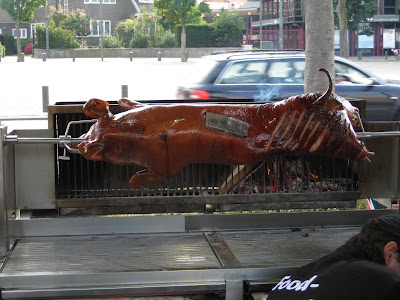
Others not so much. I think this booth was German. This really smelled good, but I couldn't bring myself to actually eat that.


These are cherries grown just a few kilometers from our house. We definitely bought some of them.


Jim really likes this dried sausage.


Several countries were offering it - Spain, Italy, France. We bought some from this French guy.


And here's what was sold at the USA/UK booth - FUDGE. Surprised? Fudge is impossible to purchase here and nearly impossible to make too. I love the fudge made with marshmallow creme and chocolate chips - neither of which are available here. With all the chocolate, I guess they just don't need fudge.

Smakelijk!

17 July 2011

The Unearned Advantage


Perhaps you are familiar with this website - TED

It's a website devoted to speeches with information the public may find interesting, educational, inspiring, etc.

This video with speaker Jay Walker gives an interesting perspective on Chinese learning English . . .


Really?

The following is an excerpt from an article I read recently about this topic I've also written about myself, but this says it so much better.

~~~~~~~

One of the cornerstone principles of diversity is that of unearned, unacknowledged privilege – if you are benefiting from the rules you are blissfully unaware that others are disadvantaged by them.

You enjoy a privileged position, and, because of this you continue to advance and receive benefit while others fall further behind. Likely you are completely oblivious to this privilege, and would deny its existence if confronted.

Australian sociologist Professor Bob Pease says that given that the flipside of oppression and social exclusion is privilege, the lack of critical interrogation of the position of privilege allows those receiving the most benefit to reinforce their dominance. In other words – when you hold all the cards, you don't have to cut anyone else in on the deal.

Think this doesn't happen, or only happens to other people? What's your mother tongue? Chances are if it is English - and in particular if you are working in one of today's multinational firms - you are enjoying the unearned and unacknowledged privilege described above. And your non-native English-speaking peers are falling further and further behind.

How does linguistic privilege manifest itself?

Sometimes it's overt as a German executive in a British multinational firm, who was part of a 10-person European task force reports. The language of the meetings was English, and discussions were invariably dominated by the two team members from the United Kingdom (the group's only native English speakers). When she asked one of them to speak a little more slowly, she was told 'it is assumed if you are at this meeting that you have a language level sufficient to follow the discussions. If not perhaps you should not be here'.

The same effect is observed online – chat groups and forums are overwhelmingly conducted in English (60 percent of web pages today are in English, as are 60 percent of all Google enquiries) which in no way reflects the fact that fewer than 10 percent of the world's 6.5 billion people speak English as their native tongue.

One area where the inability to accommodate speakers of other languages is costing real money is in the field of knowledge management. Company intranets, educational journals, global think-tanks and multilateral agencies all use English as their main, or often sole, language.

According to Konosuke Matsushita, Founder of electronics giant Matsushita Electric, "Business is now so complex and difficult, the survival of firms so hazardous in an environment increasingly unpredictable, and fraught with danger, that their continued existence depends on the day-to-day mobilisation of every ounce of intelligence."

If this is true, what about all the intelligence that we can't even begin to access, because of our insistence it is communicated in English?

Since language plays such a critical role in human interaction, how much innovation is being lost because of English language dominancy?

According to Dr David Hill of the World Innovation Foundation, over 99.8 percent of the world's population are excluded from any involvement with scientific and technological research, and less than one-twentieth of one percent of the world's population are engaged in the planet's leading edge research effort. This comes at incalculable cost to mankind.

It is important to eliminate 'unearned advantage' at all levels if you want to capitalise on the wealth of resources, talents and abilities within your environment. Reducing unearned advantage at the personal level starts with becoming aware.

Mary van der Boon is founder and principal of global tmc international management training & consulting based in the Netherlands. She is a native English speaker.

~~~~~~~

Something to think about . . .

You may also find this slightly longer (10 min) video of a speech given by Patricia Ryan both interesting and insightful.


I am in no position to make a big difference, but perhaps we can all make a small difference along the way. I may be in that privileged, (unearned) advantaged minority that is a native English-speaker, but the very least I can do is be aware of the wealth of knowledge that many privileged, native English-speakers simply dismiss.

15 July 2011

Gelukkig Verjaardag Frazier


Frazier will be 2 years old tomorrow!


Happy, happy birthday, Frazier!

14 July 2011

infographics ii


Reason #8,479 why AT&T's slogan should be "Think Impossible" rather than "Rethink Possible".

The internet at our house in Jefferson hasn't been used in quite some time so I finally got online to cancel it. It's with AT&T and frankly, it's been nothing but trouble since the switch was flipped.

So, now, all I wanted to do was get back in the switch-flip line. Since AT&T is at the forefront of technology, one would think this could be painless.

Think again.

AT&T is either (1) not at the forefront of technology or (2) they have a helluva marketing plan for a lifetime sentence on their service. Either are equally likely. On their website, you can do nearly anything - view or pay your bill; add, move or change your service; get a free college education . . . but you cannot, under any circumstances cancel your service ONLINE.

A 1-800 phone call is required, ma'am.

Despite my live-chat lying and scheming - "But I'm in a foreign country" - "My bagphone is solar-powered and it's cloudy here all the time" - "I will cancel my autopay. That should do it, right?", nothing would convince AT&T to allow me to do the impossible. Cancel my service ONLINE.

So I called.

I tell you this as a warning.

You may remember (if you read my blog from time to time) that when we moved to Belgium and opened a bank account, I asked about getting a checkbook. The bank employee looked confused so I pulled out my checkbook from the States. She looked it over perplexed and then said "We haven't had those in 15 years."

I love infographics. Tons of information at a glance and easy to understand.

It appears that you will soon be able to forget your checkbook, credit cards, and even your wallet. Just make sure you've got your cell phone because that's all you'll need.

I know, this graphic is huge.


INFOGRAPHIC: Goodbye Wallets! How Mobile Payments Are Becoming the New Credit Card


I think I will forego signing up with ISIS. Guilt by association.


~~~~~


I guess this puts things into perspective. There really are a lot of Asians.


~~~~~


Think your gas is expensive?


United States vs. World Gas Prices


~~~~~


And speaking of perspective . . .


~~~~~


And last, but not least . . . heaven help us.

13 July 2011

Foto's and more foto's


I'm not sure of the grammatical rule, but foto's (with an apostrophe) is the correct spelling of photos in Dutch.

I've taken well over 10,000 pictures in the last two years. Mostly of places, many of people, and some like this . . .


This is an Asian boy with his very own camera, of course. This is what he thought was worth remembering about his trip to Dusseldorf, Germany.


These are sardines on our grill. They're bigger than the ones usually in a can, and no, I did not eat one.


This is the one and only piece of art in our dentist's waiting room. I thought it was funny as well as unique waiting room decor.


Hundreds of these little brass plates are in nearly every city - if you look for them. They symbolize something significant about the city. These owls are in Dijon. I asked a souvenir shop owner why so many souvenirs in Dijon had images of owls. He explained that one of the sculptures on the Notre Dame Cathedral had an owl on it and was considered a good-luck charm. When we were in Dijon, I looked and looked, but never found that owl.


This one is from Aachen, Germany and unfortunately I have no idea what it symbolizes.


This is from Tongeren, Belgium. Tongeren is the oldest city in Belgium, founded in 15 BC as a base and supply station for Roman troops. Pictured on this brass plate is Ambiorix, a rebel leader against Roman invaders. He is the local hero although it is unknown where he lived exactly and perhaps if he really existed. The only source to mention him is Julius Caesar's own Commentarii de Bello Gallico (1st century BC).


These are the brass plates in Hasselt. The symbol of Hasselt, an "H" in a hazelnut. Hasselt comes from Hasaluth, meaning hazel wood.

There are many legends about hazel wood and hazelnuts. They are said to inspire poetry and wisdom. An ancient Gaelic tale is that nine hazel trees grew around a sacred pool, dropping nuts in to the water to be eaten by some salmon which thereby absorbed the wisdom.

Hazel wood is often used to make shepherd's staffs and walking canes due to its pliancy.


I took this outside a souvenir shop in Hameln, Germany. These are bumper stickers with popular German names. Stephan/Steffen and Sascha didn't make the German top 10 names in 2010. Sofie & Maximilian were at the top. And in Belgium: Emma & Noah and America: Isabella & Jacob.


This foto is taken from our patio. Just in front of that huge willow is a pear tree.


Close-up. This tree is loaded, but they're all about 50 ft. up.


This is my collection of postcards of most everywhere we've visited since moving to Belgium. We've been lucky enough to see so many wonderful cities and little towns. I started this collection because I learned that, Corey, a friend of Randi's collected postcards. From that point on I always got one for me and one for him. Thanks, Corey for this great idea.


Every once in a while when I'm at a souvenir shop I also buy a magnet so I always have one for those special art projects I sometimes get :)


And also while in Dijon, France, we came upon this sign in a pharmacy window. It got our attention. That's all I'm saying.