09 February 2011

Margarides i més


Margaritas and more

Before leaving for Barcelona, I researched common foods for the region as wel
l as "the best food and drink". We were able to find a couple of places mentioned
and found a few more that weren't.


This is La Boqueria - a food market off Carrer (street) de la Rambla


The food was so fresh and displayed beautifully.


These booths were near the entry of the market

Then we turned a corner and . . .

D'Alerta! (Warning!)

Proceed at your own risk


Remember that word in the event you are looking at a menu in Catalan.


There's a market for this?!


Who buys this?!
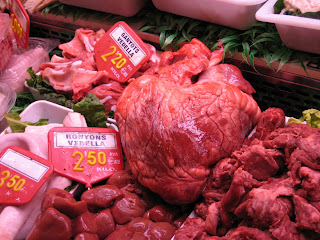

Better question . . . who eats this?!
Don't answer that.

And Jim wonders why I eat like a 10-year old at restaurants. I don't think I need worry about any of that ending up on my cheese pizza.


Now, here's something worth eating.


This is a dessert called Crema Catalana. Much like creme brulee', it is quite good. The main difference in the two is that creme brulee' uses heavy cream and Crema Catalana is oven baked using a mixture of milk and cream with cornstarch to thicken.

Sometimes called Crema de Sant Josep after Saint Joseph, the husband of the Virgin Mary. Saint Joseph's Day is celebrated on March 19th and pays homage not only to this Saint, but to all fathers. Crema Catalana is a traditional dessert to serve on this day, which is treated much like the U.S. Father's Day.


Farggi is a coffee and ice cream shop with locations in Spain and Portugal. I got a cappuccino, which was excellent, but it was Jim's hot chocolate (literally liquid chocolate) that was really unbelievable.


According to the New York Times, this is the best sandwich that guy ever ate. Naturally, we had to try it.


Cafe' Viena - located on the famous pedestrian-friendly La Rambla.


The bread was crispy and a bit salty and the meat is a thin salt-cured ham. I'm not a sandwich connoisseur, but it was a good sandwich.

We never found Pizza del Born which touts the best pizza in Barcelona. I really love pizza so we must make a more concerted effort to find it next time!

And now to the good part.


I'm not an expert on margaritas. Yet. I'm working on it. It's my favorite cocktail and I think I know a good one when I drink it. Supposedly the best margarita in Barcelona is at a bar called Margarita Blue. Of course we had to try it.

Souvenir/handy cocktail mixing guide


In my opinion, it is not only the best margarita in Barcelona, it is the best margarita I've ever had.
Margarita Blue - bar and restaurant.

07 February 2011

Park Guell


Park Guell is situated on the hill of el Carmel in the Gracia district of Barcelona. The site was originally a rocky hill with very few trees.

Designed by Catalan architect Antoni Gaudi and built between the years 1900-1914, the park was originally part of an unsuccessful housing development - the idea of Count Eusebi Guell, whom the park is named after.

The intention was to exploit the fresh air and beautiful views with sixty triangular lots for building luxury houses.


It already included this large country house called Larrard House and was next to a neighborhood of upperclass houses called La Salut. Count Eusebi Guell moved into Larrard House in 1906.

Ultimately only two houses were built, neither designed by Gaudi. One was intended to be a show house. It was put up for sale, but there were no buyers.


Gaudi, at Guell's suggestion, bought it with his savings and moved in with his family. This house, where Gaudi lived from 1906-1926 is now the Gaudi Museum.


The huge public square in the center of the park is surrounded by a continuous wall and bench.


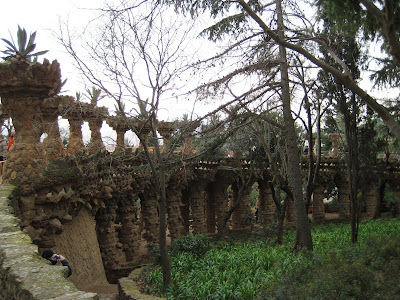
The entire Guell Park is made of stone, ceramic, and natural elements.


The public square sits atop the Doric temple with a great view of Baracelona.


FYI - Original Greek Doric columns stand directly on the flat pavement of a temple without a base; their vertical shafts are fluted with 20 parallel concave grooves and topped by a smooth capital


For the mosaics, Gaudi used broken ceramic tiles, plates, and cups to recycle rather than make new ones.


To avoid leveling the land, Gaudi designed meandering viaducts and planned the park to include lots of trees.


The footpath under the viaduct.


All of Gaudi's work seems almost childlike.


The park caretaker's lodge looks almost like something out of a fairy tale.

On a completely separate note: We lived in Alexandria, Louisiana several years ago where there is an entire neighborhood with houses similar to this. The streets are named Candy Lane, Snow White Drive, Gingerbread Road, Gretel Court. I searched and searched the internet, but could never find an image of this neighborhood - an unbelievably bold move by the developer.


The entrance to the park is very lush and green.
You can see visitors on top of the temple looking out over the city.


The park is free to visitors and most definitely worth a visit.

05 February 2011

Colom i Placa d'Espana i Corrida


Columbus - Spain Plaza - Bullfight
(sounds better in Catalan doesn't it?)

Colom i Placa d'Espana i Corrida


Monument a Colom, a statue sculpted by Rafael Atche' is located at the site where Columbus returned to Spain and to Queen Isabella and Ferdinand after his first voyage to the Americas. That building in the background looks like it's leaning, but I'm pretty sure it wasn't.


It is said to depict Columbus pointing towards the New World with his right hand, but instead of pointing west, the statue actually points east - supposedly towards Columbus's home of Genoa.

A very brief History 101:

Portugal and Castile (now Spain) were rivals at one time and in 1485, Columbus presented a plan to the King of Portugal for a voyage across the Atlantic, butit was rejected.

In 1488, he appealed to the court of Portugal a second time, but was again turned down. Not being deterred, in 1489 he presented his plan to Queen Isabella I of Castile. Her advisors told her to pass on the idea, but for unknown reasons - probably so he wouldn't take his ideas elsewhere - Queen Isabella gave Columbus an allowance and a letter ordering all Castilian people to provide him food and shelter at no cost.

Finally in 1492, with about half the funding fromItalian investors he secured on his own, he had a contract with the Queen - should he claim any new land for the crown, he would be highly rewarded.

He didn't actually reach the Americas on this first voyage, but he did make it to what is now the Bahamas. On his return, he landed first in Portugal, then in March 1493 landed in Barcelona - ironically at the very sight of this monument.


The monument to Columbus was constructed between 1882 and 1888, the entire construction (labor and materials) done by Catalans, and almost entirely from money privately raised.


Placa d'Espana was built for the 1929 International Exhibition. The square was built on the site that had previously been used for public hangings. It's a huge monument. You can see one of the Venetian columns on the right - there are two so I presume the other one got hidden behind the monument.


It is one of the city's biggest squares with a traffic roundabout and the junction of several major thoroughfares. It is a very busy place and really beautiful at night.


In the background you can see the Arenas de Barcelona - a bullring.

Bullfighting is an important part of Spanish culture and its origins are ancient with the earliest recorded date back to 711 AD when a bullfight (corrida) took place in honor of the crowning of King Alfonso VIII. It is estimated that over 2400 bulls are killed each year in front of enthusiastic crowds of over 30 million spectators. I just don't get it.


The regional parliament in Barcelona recently passed a law to ban bullfighting in Catalonia and the law becomes effective January 1, 2012. Although bulls will no longer die each year in bullfights in Catalonia, it hasn't stopped a similar suffering with the bous al carrer (bulls in the street).

Originally built in 1898, the bullring was abandoned in 1990 as the popularity of bullfighting decreased in Catalonia. In 2003, British architects announced they would team up with a Barcelona firm to revitalize the bullring with retail and office space. However in 2009 with economic difficulties, the project was halted. As you can see from the photo, sadly, it remains incomplete.

04 February 2011

Ciutat Vella


Old City

Between La Rambla Street and Via Laietana Street are two areas that are part of the old city of Barcelona. One called El Born and the other Barri Gotic (Gothic Neighborhood).


Many of the buildings date from medieval times, some from as far back as the Roman settlement of Barcelona. You'll find very narrow streets with quaint cafes and shops.

El Born


Barri Gotic


This is Cathedral de Barcelona. It was constructed throughout the 13th - 15th centuries over the crypt of a former Visigothic chapel and faced the Roman forum of Barcelona.


As you can see, it is under renovation as most cathedrals are. I was the only one interested in going into the cathedral so we didn't! That was that.

03 February 2011

La Font


The Fountain


The Palau Nacional was erected for the 1929 International Exhibition and houses the Museu nacional d'Art de Catalunya (MNAC).

FYI - The first modern public exhibition was held in London in 1756. World's Fairs originated in the French tradition of national exhibitions, and culminated with the French Industrial Exposition of 1844 held in Paris.

It was soon followed by other national exhibitions in continental Europe and finally came to London where the first real International Exhibition was held on May 1, 1851 and nearly every year after.


It is the largest museum in Catalonia and also the most important center for Romanesque Art in the world.


And really beautiful at night.


Just at the base of the Palau Nacional is the Montjuic Magic Fountain.


Also built for the 1929 International Exhibition, the Montjuic Magic Fountain, designed by engineer Carles Buigas, was completely restored for the 1992 Barcelona Olympic Games. Every year, the Magic Fountain is the chosen site for the "Piromusical", a huge firework display with a music and laser show, which is the closing event for Barcelona's main festival, La Merce'.

FYI - La Merce' is the annual festival held since 1871 to observe the Roman Catholic feast day (September 24) of Our Lady of Mercy, La Mare de Deu de la Merce, in Catalan. Parades include papier mache' giants known as gegants i capgrossos and a popular dance, where participants form a circle, called the Sardana.

But every evening at 7:00 pm, you can see this . . .